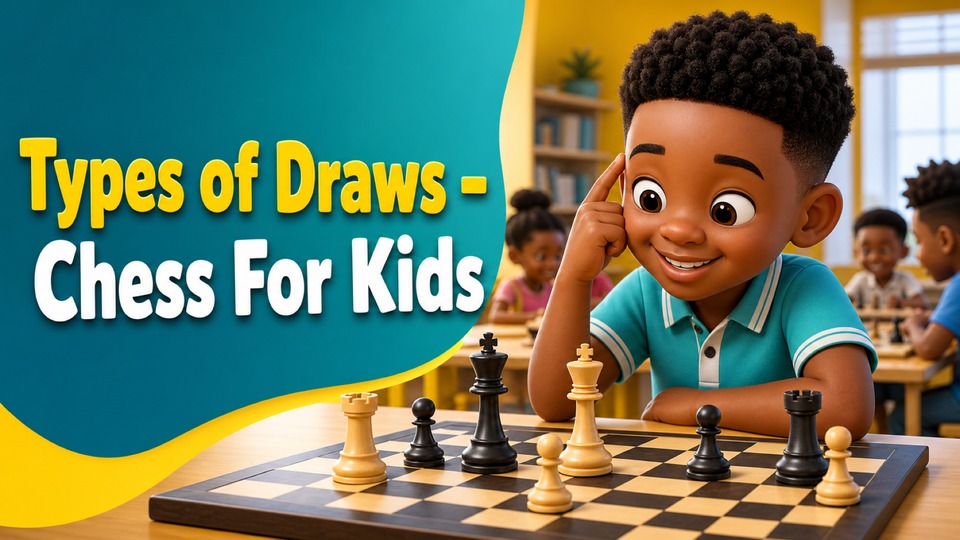
Types of Draws - Chess For Kids | Kids Academy
2019 · 8m
Synopsis
There are 5 most common ways to tie the chess game. 1. Insufficient checkmating material This type of draw happens when none of the two players can make a checkmate. Which means that none of the players have enough moves or pieces to get a checkmate. 2. Threefold repetition It happens if a chess position is repeated three times in a single game by both players. It means that a piece makes the same move back and forth three times. When both the players make these repetitive moves, the game is draw. 3. Stalemate It happens when one player has a safe king, but it has no moves left because it is surrounded by the opponent. However, it is surrounded in a way that the opponent cannot attack its king. 4. Draw by agreement This happens when one player offers the other player to draw the game. It happens when a game is already reaching the draw condition. The opponent can either make their next move or they can accept the draw offer. 5. 50 moves rule This happens when both players play 50 moves without moving a pawn or capturing a piece, any player can claim a draw. This kind of draw is least likely to happen Subscribe to our channel: #TalentedAndGifted #LearnWithKidsAcademy Kids Academy Talented and Gifted Program for kids aged 2-10: ***** Connect with us on : App Store: Google Play:
You Might Also Like
WELCOME TO THE KENYAN HISTORIAN | Kenya's Ultimate Channel for Captivating Documentaries. | Thank You
THE TITANIC FALL: The Decline of Webuye's Paper Mills
Exercise 2
A Teacher
SS 1 Physics
SS 2 Physics
Literature - ENEM: Exercise XXX - Arcadianism
MILITARY AND WAR: Inside British Army Training Camp in Kenya. Why #BritishArmy /Soldiers Are Here.
Pink Flamingo
Sexual Reproduction Lesson for Kids
SSS11 Biology
SSS 1 Chemistry
Comments
1 Comments
There are 5 most common ways to tie the chess game. 1. Insufficient checkmating material This type of draw happens when none of the two players can make a checkmate. Which means that none of the players have enough moves or pieces to get a checkmate. 2. Threefold repetition It happens if a chess position is repeated three times in a single game by both players. It means that a piece makes the same move back and forth three times. When both the players make these repetitive moves, the game is draw. 3. Stalemate It happens when one player has a safe king, but it has no moves left because it is surrounded by the opponent. However, it is surrounded in a way that the opponent cannot attack its king. 4. Draw by agreement This happens when one player offers the other player to draw the game. It happens when a game is already reaching the draw condition. The opponent can either make their next move or they can accept the draw offer. 5. 50 moves rule This happens when both players play 50 moves