MOOC Interdisciplinary Sustainable Architecture | Universitat Politècnica de València UPV
2018 · 130m
Synopsis
Este canal forma parte de un MOOC (curso abierto y masivo) que puedes encontrar en
You Might Also Like
 Movie★ 0
Learn English With Disney Movies
 Movie★ 0
CoComelon #shorts
 Movie★ 0
All New Akili & Me
 Movie★ 0
Learn about Good Habits & Good Manners for Kids
 Movie★ 0
Emanuella And Success Comedy
 Movie★ 0
🎬⭐️ BRAND NEW Episodes | Talking Tom Shorts: Season 3 🤣💙
 Movie★ 0
How to Be a Better Human
 Movie★ 0
Numberblocks & Alphablocks - Learn to read and count #readingmonth
 Movie★ 0
Learn about Safety Tips for Kids!
 Movie★ 0
Sleepytime! 💤 | Learn Words with Yakka Dee |BBC Kids
 Movie★ 0
⏰🤣 Hours of Fun | Talking Tom Shorts Compilations
 Movie★ 0
New Compilations | Chuggington
Comments
10 Comments
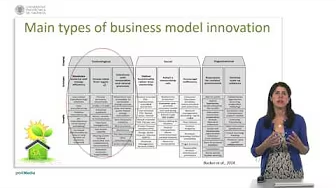
Título: Business models for innovative climate change technologies Descripción automática: In this video, Elena de la Poza, an associate professor, discusses the concept of business models for sustainability and identifies key stakeholders. The primary goal is to understand the roles these models play in sustainability and to recognize the challenges and prospects in their development. De la Poza defines a business model as a tool allowing companies to analyze, compare, and assess their business while focusing on sustainable competitive strategies through product design and cost structure. The process for creating a sustainable business model begins with formulating a business strategy that clarifies the company's mission, goals, target customers, and the value provided. The creation of the model includes three key elements: value creation, production of services and goods for economic return, and value capture through cost structure and revenue streams. Sustainable models aim for posi
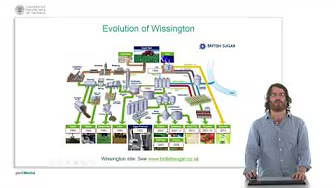
Título: Integrated Design Process Descripción automática: In this video, a lecturer from the University of Cambridge discusses the role of integrated design processes in achieving sustainable development in the manufacturing sector. He presents a framework that considers the purpose, appropriate processes, and necessary participants to align with sustainability objectives. The lecturer then outlines two case studies as examples to illustrate his points. The first case study features a UK-based sugar company that faced economic and environmental challenges. To increase sustainability and diversify their product range, the company developed a biorefinery, producing various by-products such as animal feed, bioethanol, and even electricity. They utilized waste heat and CO2 to grow tomatoes and sought new collaborations to enhance their business model and secure their raw material supply chain. The second case study discusses a startup focused on reducing the environmental impact of persona
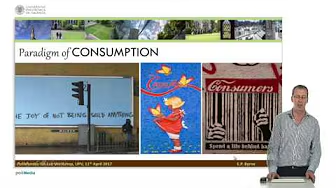
Título: Context, Framing, Risk, Uncertainty, and Integrative Approaches to Complex Sustainability problems. Descripción automática: In this video, a presenter from University College Cork presents at the poliMedia workshop in April 2017, discussing various aspects of sustainability and societal frameworks. The presenter examines the question of whether our society is sustainable and highlights the rising greenhouse gas emissions and the exceeding of Earth's biocapacity, indicating the need for multiple Earths to sustain current consumption levels. The presenter underlines the complexity of natural and sociotechnical systems, acknowledging challenges in predicting their consequences due to their interconnectivity and feedback loops. The presenter also explores framing and perceptions of reality, pointing out that different disciplinary perspectives can reveal partial truths or delusions. The presenter presents evidence on the varying sustainability of different fuels, illustrating how s
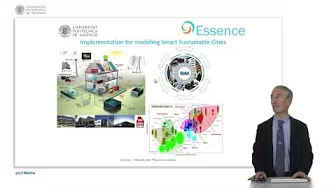
Título: Life cycle analysis Descripción automática: In this video, the instructor introduces the life cycle analysis submodule within the overall module for the physical transition in the "Essence Blended Learning Course for a Sustainable Future in Sustainable Cities." The discussion emphasizes the importance of life cycle analysis for cities and buildings, considering their entire lifespan, with a city cited as an example due to its history of over two thousand years. The instructor outlines the ISO standard definition of life cycle analysis (LCA), as a method used to assess environmental impacts associated with products, buildings, or cities by analyzing relevant inputs and outputs. The video goes on to mention different elements to be considered in a city's life cycle, such as material usage from raw state to final waste management or recycling. It delves into the LCA analysis chain, highlighting the significance of embodied energy and the influence of transport elements. Quantitati
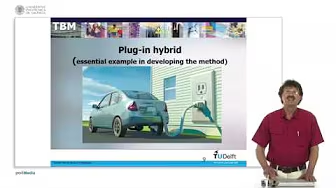
Título: How to improve energy systems to become more sustainable? Descripción automática: In this video, the speaker discusses approaches to improve sustainability in energy systems. He begins by explaining their initial strategy, which used international sustainability indicators to measure the "distance to target" for each indicator within the system, aiming to address those furthest from the target first. However, this method proved to be ineffective for generating practical, innovative solutions. The speaker emphasizes the need for system thinking in energy innovation, rather than focusing on isolated components. The speaker references a strategy of problem solving: “If you cannot solve the problem, enlarge it.” This paradoxical advice implies that widening problem boundaries can lead to more creative solutions. He also mentions a report from an national academy of science which recommends exploring integration in energy systems research, ranging from creating multisource multiprod
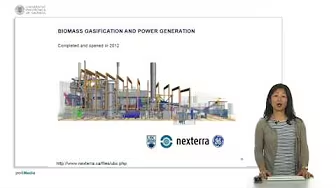
Título: CAMPUS AS A LIVING LAB Descripción automática: In this video, a professor in chemical and biological engineering at a university in Vancouver, Canada, presents at a workshop in Valencia, discussing the university's campus as a living lab initiative focused on sustainability. The city, known for its mild climate and environmental activism, is home to the university, which integrates sustainability into its core functions of teaching and research. The institution, attracting nature-oriented and sustainability-conscious students, has surpassed its greenhouse gas (GHG) reduction targets for 2015 and aims for further reductions by 2020. The professor highlights the university's commitment to sustainability, mentioning its greenhouse gas reduction achievements and describing a bioenergy research and demonstration facility. The facility employs a local technology to convert wood waste into energy, heating campus buildings. She also touches on a carbon tax in the province as a key driv
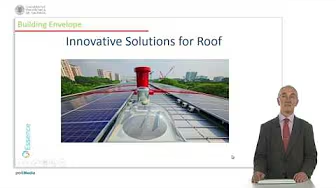
Título: Facades materials selection Descripción automática: In this video, the presenter presents the second part of a series on architectural efficiency, focusing on the constraints and solutions for facade materials selection. He discusses different structural systems and how to assemble modular units to a building's basic structure, emphasizing the importance of mechanics in material choice. The presenter also addresses the need to prevent thermal bridges and accommodate material expansion or contraction due to temperature changes by using flexible assemblies. He outlines the integration of passive and active systems into facades, including innovative solutions such as photovoltaic layers and green infrastructure, to improve building efficiency. The use of new materials like perovskites and supercapacitors is discussed for energy generation and storage. Additionally, he suggests smart design can enhance natural light and air distribution inside buildings. The presenter moves on to i
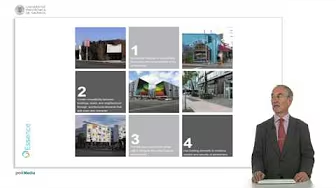
Título: Facades constraints Descripción automática: In this video, the presenter explores the topic of architectural efficiency with a focus on the performance of facades through material selection. He examines the evolution of facade design from historical examples such as iconic ancient temples and medieval fortresses to modern structures like famous stadiums and buildings by renowned architects. With the advent of new materials, including polymers and metals, the impact on facade design and the resulting aesthetic, urban-cohesion, and functional aspects like comfort and security is highlighted. The presenter discusses the importance of considering various architectural constraints when selecting materials for facades. These constraints include aesthetics, urban integration, provision of views, and the incorporation of elements that cater to human needs. The role of the facade in unifying building design with its surroundings and its potential to enhance the neighborhood is emphasize
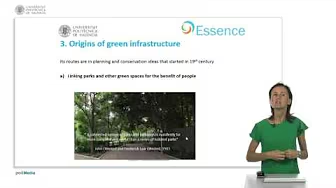
Título: Green infrastructure. Introduction Descripción automática: In this video, a lecturer at a polytechnic university provides an overview of green infrastructure. She breaks down her presentation into five parts, starting with the definition of green infrastructure, its components, origins, and the concept of multi-functionality within its framework. She emphasizes the versatility of green infrastructure, explaining its implementation at various scales from regional to local, and lists examples such as reserves, parks, wetlands, and urban green spaces. The lecturer traces the origins of green infrastructure back to 19th-century planning and conservation theories focused on the benefits of linking parks and natural areas. Multi-functionality is presented as a key aspect, with green spaces serving multiple purposes and offering ecosystem services, illustrated by a public garden serving various roles from cooling the air to providing recreational space. The video concludes with the le
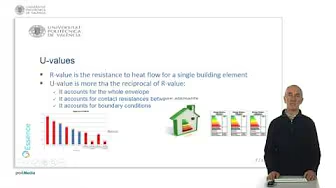
Título: Passive systems Descripción automática: In this video, the speaker discusses the importance of passive systems and energy management in buildings, emphasizing thermal comfort, which should account for humidity, temperature, and the interplay between a person and their surrounding spaces. It is underlined that wall and roof temperatures, as well as radiation, are significant to achieving thermal comfort, with standards set to define acceptable temperature ranges. The conversation then moves on to the necessity of understanding and regulating the dynamic movement of air and heat within a building, considering both external environmental impacts and interior factors like activity levels and air quality, which all contribute to personal comfort. It's noted that buildings account for a substantial 42% of energy use, compared to industry and transportation, highlighting the potential for significant energy savings through better management. The concept of passive house design is intr