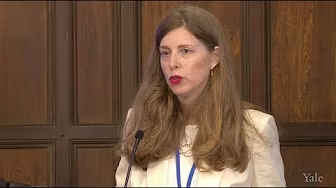
ISPS DEMOCRACY SERIES: “Governing Citizens’ Assemblies”
2024 · 393m
Synopsis
In recent years, citizens’ assemblies — large randomly selected bodies of citizens convened to deliberate about political issues — have become a popular way for governments to address governance and legitimacy issues. These bodies of ordinary people are entrusted with the goal of generating policy recommendations and, sometimes, even legislative proposals on issues such as electoral reform, abortion, same-sex marriage, climate justice, and assisted suicide. As citizens’ assemblies may come to occupy a larger role in democratic governance, important questions need to be addressed: Who holds power within and over citizens’ assemblies? And who should? Citizens’ assemblies have so far been governed from the outside by government officials, experts, and professional facilitators. How much of the power belongs and should belong to the citizen participants themselves? This conference at Yale’s Institution for Social and Policy Studies assembled academics, political leaders, and practitioners to explore these critical questions. The focus was on the recent French Citizens Conventions, respectively on Climate and End of Life, which explicitly thematized the question of governance. Link:
You Might Also Like
Numberblocks & Alphablocks - Learn to read and count #readingmonth
Top Videos
KS3 Drama
SS 3 Chemistry
Charlie and Lola - Season 1
African
Learn English With Disney Movies
Test Your English with TV Series and Movies
Masha & the Bear
CoComelon Lane | NEW Netflix Kids Show
CoComelon #shorts
All New Akili & Me
Comments
4 Comments
At the ISPS Governing Citizens’ Assemblies Conference on February 28, 2024, Alexandra Cirone, Assistant Professor of Government at Cornell University and Visiting fellow at the Yale Institution for Social and Policy Studies, moderated a roundtable discussion on whether citizens’ assemblies should be more like sovereign parliaments. • Thierry Beaudet, President of the French Economic, Social and Environmental Council • Cristina Lafont, Professor of Philosophy at Northwestern University • Hélène Landemore, Professor of Political Science, Yale University; Distinguished Researcher, Oxford University Institute for Ethics in AI • Myriam Souami, Member of the Citizens’ Convention on End-of-Life Issues
At the ISPS Governing Citizens’ Assemblies Conference on February 28, 2024, Colin Scicluna, Head of Cabinet to the Vice President for Democracy & Demography, European Commission, moderated a panel on International Perspective on Citizens’ Assemblies and other Democratic Innovations Governance. • Jane Suiter, “The Ongoing Internal Evolution of Citizens’ Assemblies in Ireland” • Antoine Vergne, “Governing Citizens’ Assemblies: A Reflective Approach Leading to Two Blueprints” • Min Reuchamps , “Governing Permanent Citizens’ Assemblies in Belgium” • Claire Mellier, “The 2021 Global Citizens’ Assembly on the climate and ecological crisis: A power-sensitive exploration of governance” • Reaction by Claudia Chwalisz and Gaëtane Ricard-Nihoul
At the ISPS Governing Citizens’ Assemblies Conference on February 28, 2024, Jane Suiter, Professor of Political Communication at Dublin City University, moderated a discussion on Citizen Voice and Minorities Representation, and Leadership in the French Citizens’ Conventions • Christiane Rafidinarivo, “Representation of Minorities Within Citizens’ Assemblies: the Experience of the Citizens’ Convention for Climate” • Miguel Von Fedak “Stories of Discontent: Moments of Tension and Distrust in the • French Convention on the End of Life” • Marjan Ehsassi, “Blueprint for Activated Citizenship: Designing for Legitimacy & Transformative Change • Reaction from online participants: Mathieu Sanchez (member of the Citizens Convention for Climate), Harry Alzire, Martial Breton, Soline Castel, and Léo Van Nieuwenhove (members of the Citizens’ Convention on End-of-Life Issues)
Hélène Landemore, a professor of political science anda faculty fellow with Yale’s Institute for Social andPolicy Studies (ISPS), served on the governance committee of the 2023 French Citizens’ Convention on End-of-Life. She organized a conference on February 28, 2024 at ISPS on how to best govern such assemblies, convening expert researchers, practitioners, and citizen participants. Following an introduction, the first session included a panel on “Who Governed the French Conventions?” moderated by Antonin Lacelle-Webster, postdoctoral associate with the Democratic Innovations Program at ISPS • Sandrine Rui : “What Does Governing a Citizens’ Assembly Mean: Power and Contingency at the Citizens’ Convention on End of Life” • Jean-Michel Fourniau on the Citizens Convention for Climate (CCC): “Political Mandate and Governance of a Citizens’ Assembly” • Chloé Santoro: “Voting in a deliberative process: what, when, how to vote and who decides?” • Hélène Landemore and Théophile Pénigaud: “The