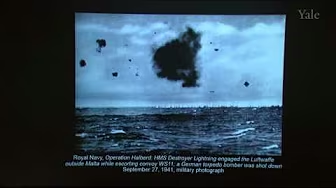
"In the Same Boat”: British and American Visual Culture During the Second World War
2015 · 457m
Synopsis
“In the Same Boat”: British and American Visual Culture During the Second World War On December 8, 1941, immediately following the declaration of the American entry into World War II, President Roosevelt telegraphed Prime Minister Churchill, “Today all of us are in the same boat with you and the people of the empire and it is a ship which will not and cannot be sunk.” This two-day conference in the Department of the History of Art at Yale University, held on the seventieth anniversary of VE-day, investigated the textured relationship between war-time visual cultures of America and Britain. The papers considered the cultural origins of the postwar political and economic bond which came to be called the “special relationship,” and explored the various political and social pressures that shaped image-making in the two countries. This conference focused on the visual cultural exchange between the two countries, identifying parallels between the way images and culture were politically mobilized and influenced by the social impacts of war itself. This conference was made possible through support from the Terra Foundation for American Art. It was also generously sponsored by the Yale University Department of the History of Art, the Yale Center for British Art, the Edward J. and Dorothy Clarke Kempf Memorial Fund, and the Whitney and Betty MacMillan Center for International and Area Studies at Yale.
You Might Also Like
 Movie★ 0
Learn English With Disney Movies
 Movie★ 0
Educational Cartoons for Kids | Learn with Sheriff Labrador
 Movie★ 0
CoComelon & Friends Holiday and Christmas Videos for Kids | Little Baby Bum | Go Buster and More!
 Movie★ 7.7
PrePrimary English
 Movie★ 0
Baby Learning with CoComelon - Colors, Shapes and Numbers!
 Movie★ 0
Year1 English
 Movie★ 0
Let's learn about.... English Vocabulary for Kids
 Movie★ 0
Sheriff Labrador Popular Live Stream
 Movie★ 0
🎬⭐️ BRAND NEW Episodes | Talking Tom Shorts: Season 3 🤣💙
 Movie★ 0
Funny Cartoons for Kids | Sheriff Labrador
 Movie★ 0
Kids Songs by CoComelon
 Movie★ 7.6
SS 1 Biology
Comments
10 Comments
Tim Barringer, Kirsty Dootson, and Katie Trumpener, joined by David Alan Mellor, discuss the film, "A Canterbury Tale" (1944). This discussion was part of the conference, "In the Same Boat”: British and American Visual Culture During the Second World War, in theHistory of Art department at Yale University, May 8-9, 2015.
"In the Same Boat”: British and American Visual Culture During the Second World War Kirsty Dootson introduces the film, "A Canterbury Tale," (1944) by Michael Powell and Emeric Pressburger.
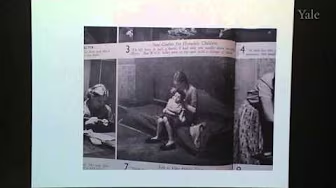
David Alan Mellor (University of Sussex) A crisis of national survival and mass mobilization, lasting from the summer of 1940 until the arrival of large numbers of American airmen, troops and amounts of materiel by the end of 1942, led to profound restructurings in the British visual imagination. Populist, Gothic and comic realisms, in graphic art and photography, were complemented by a growing engagement with technicist depictions of the spectacle of war. The Ministry of Information controlled War Artists Advisory Committee and the more Arcadian (and Harkness-funded) Recording Britain project (both chaired by Sir Kenneth Clark) were crucial to the setting of new paradigms and the advance of a burgeoning Neo-Romantic aesthetic. The ‘soft power’ of English painting and photography was assigned an instrumental presence in the US- sometimes at the highest political level- as in the case of Bill Brandt’s London blitz photographs which formed part of Wendell Wilkie’s report to President Roo
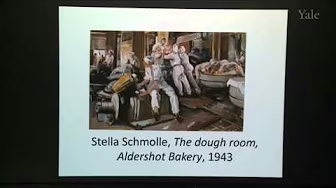
Catherine Speck (University of Adelaide) Britain appointed war artists soon after war was declared, but America was slower to respond. The British response was centralized in the WAAC (War Artists Advisory Committee) who oversaw all appointments, commissions and purchases; whereas in America the employment of artists was decentralized and mostly privatized with Life Magazine, Abbott Laboratories and a few Federal agencies commissioning artists. This paper will focus on the 'to and fro' of information between the two nations in relation to war artists schemes, and it will look at British and American women artists and the spatial zones within which they worked. The slippage between nations, linked politically and economically, but operating quite differently in relation to the employment of war artists, and women in particular, suggests two boats rowing side by side but not meeting up. This paper was presented at the conference, "In the Same Boat”: British and American Visual Culture Du
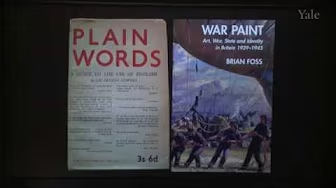
Cassius M. C. Clay (University of Cambridge) Studies of Britain’s War Artists’ Advisory Committee have neglected the major contribution of Meredith Frampton RA, who was commissioned by the agency in 1941 to portray Sir Ernest Gowers, the man responsible for coordinating London’s civil defense during the Blitz. This paper addresses the circumstances of the commission, paying particular attention to the relationships between formal portraiture, schematic organization, and representations of civic order. I argue that Frampton’s painting, set in a bunker beneath the Natural History Museum, registers this critical nerve center of the British home front in stoic but unheroic terms, echoing Gower’s own plain words: “We withstood.” This paper was presented at the conference, "In the Same Boat”: British and American Visual Culture During the Second World War, in theHistory of Art department at Yale University, May 8-9, 2015.
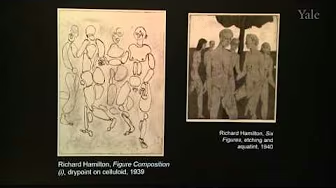
John-Paul Stonard (Independent Scholar) The art critic David Sylvester (1924-2001) launched his career during the Second World War, writing for Tribune Magazine, and meeting artists and writers in London during the Blitz. His experiences, which can be reconstructed from his own unpublished memoirs and letters, show the vitality of the London art world in the 1940s. His employment as a secretary for Henry Moore, as well as his friendship with Francis Bacon in the post-War years were the basis for his own growing position as champion of British art, strongly informed by his experience of French art. All this changed however in 1956, when Sylvester had in his own words a 'Damascene moment' while visiting the MoMA travelling show 'Modern Art in the United States' at the Tate Gallery. This paper was presented at the conference, "In the Same Boat”: British and American Visual Culture During the Second World War, in theHistory of Art department at Yale University, May 8-9, 2015.
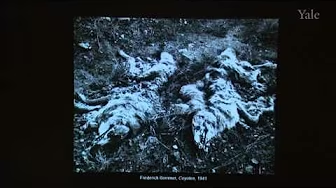
Cécile Whiting (University of California, Irvine) During World War II photographs and newsreels documenting death and destruction on battlefronts, ranging from the tropical rainforests of Guadalcanal to the beaches of North Africa, forced a change in painted representations of the landscape in the United States. Although some American artists enlisted in the military and documented battles abroad, others—whom this talk will examine—remained at home to express sentiments related to the war in paintings of the American land. In the aftermath of the Japanese attack on Pearl Harbor, many American artists devised overt propaganda, developing what some critics considered to be overheated and emotional depictions of the American land under attack or defended by heroic farmers become valiant militiamen. Yet, other painters evoked the war by registering less obvious disruptions to the bucolic ideal while offering the hope of imaginative regeneration of the nation in the face of threat. Together
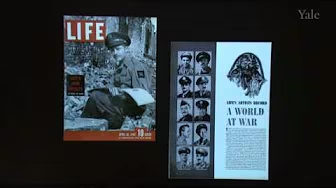
Melissa Renn (Harvard Business School) Life magazine not only sent photographers to capture World War II on film, but also commissioned artists to record in paint all aspects of the war. Modeled in part on 19th-century magazines and illustrated newspapers that hired artists to paint and draw life on both the battlefields and home fronts, as well as on 20th-century British precedents, Life’s war art program was its largest patronage project. Life viewed these wartime paintings as essential supplements to its black-and-white photographic reporting. Drawn from new archival research, my talk explores the motivations behind Life’s wartime commissions, and focuses on Life’s coverage of the war in Britain, from the Blitz to V-E Day. This paper was presented at the conference, "In the Same Boat”: British and American Visual Culture During the Second World War, in theHistory of Art department at Yale University, May 8-9, 2015.
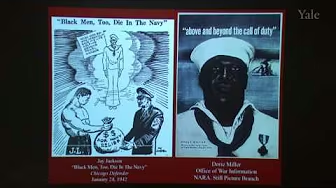
Edward Puchner (University of South Carolina) During the Second World War, the African American press featured scathing editorial cartoons to outline the paradoxical stance of African Americans within a war-torn American society. These cartoons advocated both participation in the fight against tyranny abroad, and an equal effort against discrimination on the home front. Examining the cartoons of two major African American newspapers, the Chicago Defender and the Baltimore Afro-American, that figured prominently in reflecting and shaping public response to the war within African American communities across the country, this study grounds these cartoons within the shifting debates of the African American press and re-contextualizes them as sites of significant political awareness and action. This paper was presented at the conference, "In the Same Boat”: British and American Visual Culture During the Second World War, in theHistory of Art department at Yale University, May 8-9, 2015.
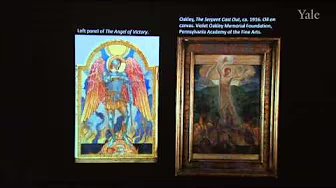
Jeff Richmond-Moll (University of Delaware) Despite its completion just weeks after the attack on Pearl Harbor, Violet Oakley’s 'The Angel of Victory' announces “Victory and Peace” to the viewer. This paper seeks to reconcile Oakley’s paradoxical vision of peace in December 1941 with the conflict to come, and considers the religious character of her efforts in an era when, as some argue, public religion otherwise seemed “wrecked beyond recovery.” During World War II, Oakley produced twenty-five portable altarpieces for American chaplains around the world. 'The Angel of Victory' presents the nascent American fight as unloseable, echoing Franklin Delano Roosevelt’s recent declaration of war: “we will gain the inevitable triumph—so help us God.” This paper was presented at the conference, "In the Same Boat”: British and American Visual Culture During the Second World War, in theHistory of Art department at Yale University, May 8-9, 2015.