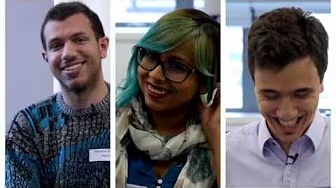
Computer Science at Oxford
2016 · 41m
You Might Also Like
 Movie★ 0
Educational Videos for Children - Lingokids
 Movie★ 7.4
Primary 6 English
 Movie★ 7.2
SS 2 English
 Movie★ 7.1
SS 1 Government
 Movie★ 7.8
KS1 English
 Movie★ 7.6
JS 2 Science & Technology
 Movie★ 7.0
Primary 4 Science & Technology
 Movie★ 0
JSS9 Science
 Movie★ 0
Nastya português 2022
 Movie★ 0
Year2 Science
 Movie★ 7.7
KS2 English spelling
 Movie★ 0
Animal Songs for Toddlers │ Sing & Learn with Little Baby Bum!
Comments
6 Comments
Science education in Africa is often held back by shortages of laboratory equipment. A team from the University of Oxford developed a novel, creative and fun approach to address this problem – hold competitions where students design and build the equipment themselves! This video describes the success of the first ‘LabHack’ competition, which was held in Harare in June 2018. Eleven teams of students from across Zimbabwe competed in a challenge to design and build frugal, reproducible laboratory equipment. The event illustrated the ingenuity and creativity of young innovators in Africa. It demonstrated that the LabHack model offers a platform for students and educators to take matters into their own hands in order to design and build the equipment they need in their institutions. For more information about the LabHack project see Video filmed and produced by Jeffrey Barbee/Alliance Earth
Want to know more about studying at Oxford University? Watch this short film to hear tutors and students talk about this undergraduate degree. For more information on this course, please visit our website at
Want to know more about studying at Oxford University? Watch this short film to hear tutors and students talk about this undergraduate degree. For more information on this course, please visit our website at More about the mathematics admissions test:

Want to know more about studying at Oxford University? Watch this short film to hear tutors and students talk about this undergraduate degree. For more information on this course, please visit our website at
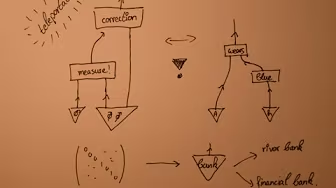
In this video I explain the basic ideas behind DIStributional COmpositional CATegorical (DisCoCat) models of meaning. These models are used in the Quantum Group (part of the Department of Computer Science, University of Oxford) to study how information flows between words in a sentence to give us the meaning of the sentence as a whole. For more information about this topic, see for example: Coecke, B., Sadrzadeh, M., & Clark, S. (2011). Mathematical Foundations for a Compositional Distributional Model of Meaning. Linguistic Analysis, 36(1–4), 345–384. For more information on how density matrices can model ambiguous words, see: Piedeleu, R., Kartsaklis, D., Coecke, B., & Sadrzadeh, M. (2015). Open System Categorical Quantum Semantics in Natural Language Processing. In Proceedings of the 6th Conference on Algebra and Coalgebra in Computer Science. MinutePhysics has been my great inspiration for making this video, check out the channel here: /minutephysics The background music is Delibera
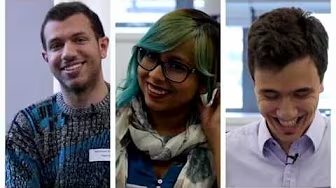
Students undertaking undergraduate degrees in Computer Science, Computer Science and Philosophy, and Maths and Computer Science undertake a Group Design Practical as a compulsory part of the course. From January, teams of four to six students battle it out. Many of the project challenges have been set, or sponsored by industry partners: in 2016, they included Research, Oxford Asset Management, Bloomberg and Metaswitch. The students' hard work culminate in an exhibition and formal presentation, held in the Department in May.